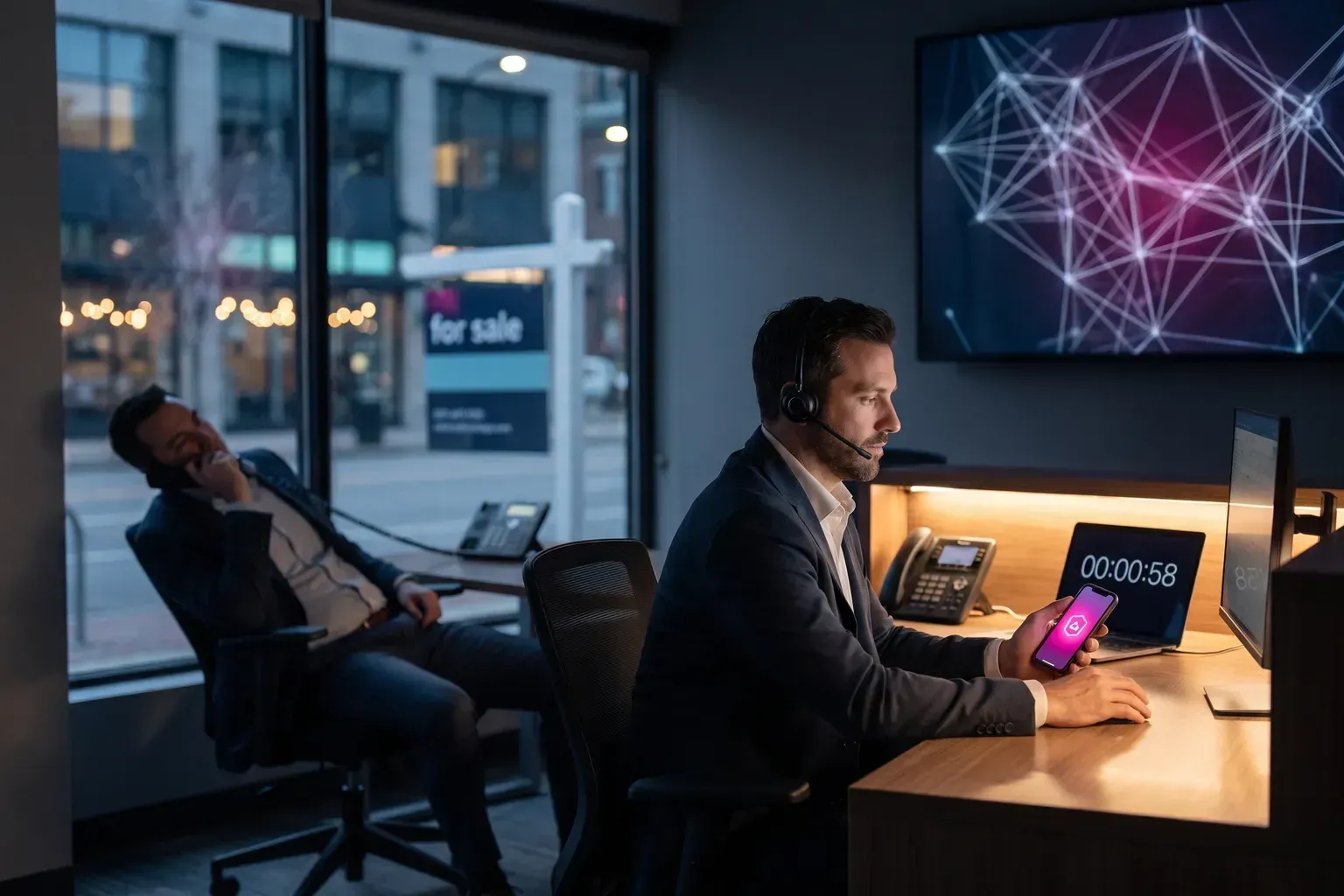
How Many Real Estate Leads Go Unanswered: 2026 Data on Missed Opportunities

by Parvez Zoha
Nearly half of all real estate leads never receive a single follow-up contact. According to research from WAV Group's secret-shopper studies, approximately 48% of online real estate inquiries go completely unanswered — representing billions of dollars in lost commission revenue annually. The real estate leads unanswered statistics paint a picture of an industry where speed-to-lead remains the single largest controllable variable separating top-producing brokerages from everyone else. Key Takeaways Research indicates roughly 48% of real estate leads receive zero follow-up, and average response times exceed 15 hours — well past the window where conversion probability peaks The landmark MIT and InsideSales.com study found leads contacted within five minutes are 21 times more likely to qualify than those contacted at 30 minutes — a finding that has only grown more relevant as consumer expectations accelerate in 2026 NAR's Profile of Home Buyers and Sellers consistently reports that 73% of buyers interview only one agent before committing, meaning the first responder captures the relationship AI-powered voice response systems now achieve sub-60-second contact on 100% of inbound leads, eliminating the human staffing bottleneck that creates unanswered lead volume Brokerages spending $20,000+ monthly on lead generation lose an estimated 40-50% of that investment to slow or absent follow-up based on industry response-rate benchmarks If you're a brokerage owner, team leader, or operations director at a residential real estate firm generating 200+ leads per month, this article delivers the real estate leads unanswered statistics you need to quantify your revenue gap — and the engineering architecture required to close it. This article covers lead response benchmarks, conversion decay curves, the financial impact of unanswered leads, AI response technology, and CRM integration requirements. It does not cover lead generation strategy, advertising channel selection, or agent recruiting. The Scale of Unanswered Real Estate Leads in 2026 The real estate industry generates an extraordinary volume of inbound leads through portals like Zillow, Realtor.com, and direct website inquiries. With approximately 5.4 million existing homes sold annually in the United States according to the National Association of Realtors' 2025 Existing Home Sales Annual Report , and each transaction typically involving multiple lead touchpoints across buyer and seller sides, the total addressable lead volume runs well into the tens of millions per year. When evaluating real estate leads unanswered statistics solutions, businesses should consider response time, integration depth, and compliance coverage. The problem is not lead generation. The problem is lead abandonment. The best real estate leads unanswered statistics platform combines fast response times with seamless CRM integration and 24/7 availability. Lead abandonment is the failure to make timely contact with an inbound prospect who has expressed interest through a form submission, phone call, chat inquiry, or portal request. Unlike lead attrition (where prospects naturally exit the funnel), lead abandonment represents prospects who were ready to engage but never received a response. Implementing a real estate leads unanswered statistics system typically delivers measurable results within the first month of deployment. WAV Group's longitudinal secret-shopper research — where trained evaluators submitted real inquiries to brokerages across multiple markets — has consistently found that close to half of all online real estate inquiries receive no response within 24 hours. Many never receive any response at all. This aligns with broader cross-industry findings: Harvard Business Review's 2011 study "The Short Life of Online Sales Leads" by James Oldroyd and Kristina McElheran, which audited 2,241 U.S. companies, found that the average first-response time to a web-generated lead was 42 hours — and 23% of companies never responded at all. For businesses exploring real estate leads unanswered statistics technology, the key differentiator is consistent quality across all interactions. I've personally listened to hundreds of inbound call recordings from real estate brokerages where the phone rang six times, hit a generic voicemail greeting, and the prospect hung up without leaving a message. That dead air between the sixth ring and the voicemail beep is where commission checks disappear. The prospect doesn't call back — they tap the next listing on Zillow and submit a new inquiry to a different brokerage within ninety seconds. Leading real estate leads unanswered statistics solutions process natural language in real time, handling scheduling, qualification, and follow-up simultaneously. Swiftleads AI exists because this gap between lead generation investment and lead response execution represents the single highest-leverage operational improvement available to real estate brokerages in 2026. The real estate leads unanswered statistics market continues to evolve rapidly, with AI-powered solutions now handling complex multi-turn conversations. Why Do So Many Leads Go Unanswered? The real estate leads unanswered statistics are not primarily a training problem or a motivation problem. They reflect a structural mismatch between how leads arrive and how agents operate: Leads arrive 24/7; agents work business hours. Portal inquiries peak between 8 PM and 11 PM local time, when agents are off-duty. Weekend and evening leads routinely wait until the next business morning. Round-robin routing creates diffusion of responsibility. When a lead is assigned to one of fifteen agents, and that agent is showing a property, the lead sits until the agent checks their CRM — often hours later. Manual dialing is slow and inconsistent. Even motivated agents require 2-3 minutes to read a lead notification, pull up the CRM record, review context, and place a call. Multiply that across multiple daily leads and the last prospects wait hours. Lead fatigue creates selective follow-up. Agents receiving high volumes from paid sources like Zillow Premier Agent often triage by perceived quality, leaving "lower-quality" portal leads unanswered entirely. Lead Arrival Window Typical Agent Availability Estimated Response Delay Monday–Friday, 9 AM–5 PM High 15–45 minutes Monday–Friday, 5 PM–9 PM Medium 1–4 hours Evenings after 9 PM Low 8–14 hours (next morning) Weekends Variable 2–24 hours Holidays Minimal 12–48 hours This table illustrates why aggregate real estate leads unanswered statistics remain stubbornly high even at well-run brokerages: the problem is temporal coverage, not agent effort. How Fast Does Conversion Probability Decay After a Lead Submits? The relationship between response time and lead qualification is not linear — it is exponential decay. The foundational research on this phenomenon comes from Dr. James Oldroyd at MIT's Kellogg School of Management, working with InsideSales.com (now XANT, acquired by Aurea Software). Their 2007 study "The Short Life of Online Sales Leads" , which analyzed over 15,000 leads across multiple industries, established findings that remain the gold standard for speed-to-lead economics: Leads contacted within 5 minutes of inquiry are 21 times more likely to qualify than leads contacted at 30 minutes After 5 minutes, the odds of qualifying a lead drop by 80% After 10 minutes, qualification odds drop by 400% relative to the 5-minute benchmark The optimal contact window is between 1 and 5 minutes after the initial inquiry These findings have been replicated and extended by subsequent research. Velocify's "The Ultimate Contact Strategy" report (now part of ICE Mortgage Technology) confirmed the steep decay curve in their analysis of mortgage and real estate lead data, finding that the first substantive contact attempt was the single strongest predictor of conversion — stronger than lead source, price point, or agent experience level. The California Association of Realtors' 2025 Digital Consumer Study reinforced the urgency dimension from the buyer's perspective: 78% of home search activity now occurs on mobile devices, and buyers who submit an inquiry from their phone expect a response before they close the app. That behavioral window is measured in seconds, not hours. Swiftleads AI achieves sub-60-second response on every inbound lead because the conversion decay curve makes anything slower a mathematical concession. The platform initiates an AI-powered voice call within seconds of lead submission, conducts an intelligent qualification conversation, and routes qualified prospects to available agents with full context — all before a human agent would typically finish reading the lead notification email. Does the "First Responder" Advantage Really Determine Who Gets the Listing? The National Association of Realtors' annual Profile of Home Buyers and Sellers — one of the largest consumer surveys in residential real estate, typically surveying 5,000-8,000 recent transaction participants — consistently reports that approximately 73% of home buyers interview only one real estate agent before making their selection. This statistic is routinely misquoted as "buyers choose the first agent who calls them back." The reality is more nuanced but equally compelling: buyers tend to commit to the first agent who demonstrates competence, availability, and relevance. In practice, the first agent to make substantive contact — not just a "thanks for your inquiry" autoresponder — captures the relationship with disproportionate frequency. One scenario I encounter regularly: a buyer submits a Zillow inquiry at 9:47 PM on a Tuesday. The assigned agent sees the notification the next morning at 8:15 AM. By then, the buyer has already spoken with a competing agent whose AI system called them back at 9:48 PM, answered three property questions, and scheduled a showing for Wednesday afternoon. The original brokerage's agent calls ten hours later and gets voicemail. That ten-hour gap didn't just delay a conversion — it eliminated it entirely. Swiftleads AI captures first-responder position by making the initial qualification call before any competing brokerage's human workflow can even begin. When 73% of buyers commit to the first competent agent they speak with, the brokerage that responds in 40 seconds holds a structural advantage that no amount of agent training can replicate. Related: What Is Speed To Lead The Metric Every Real Estate Team Lead The implications compound at scale. A brokerage generating 500 leads per month that responds to all of them within 60 seconds doesn't just improve its own conversion rate — it systematically captures first-responder position against every competitor in its market, pulling qualified buyers out of competing pipelines before those pipelines even activate. Related: Top Producing Agents Lead Response Time Data Study What Is the Financial Impact of Unanswered Leads? Quantifying the real estate leads unanswered cost requires working through the full unit economics of lead-to-close conversion. The math is sobering. See your missed-lead revenue in 60 seconds Free brokerage audit from Swiftleads AI — we calculate your current response-time gap, the lost commissions it costs, and the ROI of fixing it. No pitch deck, no engineers. Start your free audit Audit takes ~10 minutes. You get the numbers either way. Related: Speed To Lead Data Real Estate Conversion Rates Unit Economics of Lead Abandonment Consider a mid-size brokerage with the following profile (based on industry benchmarks from T3 Sixty's 2025 Brokerage Performance Benchmark Report and RealTrends' The Thousand rankings): Monthly lead volume: 400 leads Cost per lead (blended): $35 (Zillow Premier Agent, Google Ads, organic) Monthly lead generation spend: $14,000 Industry-average leads answered within 5 minutes: ~25% Leads that receive no follow-up within 24 hours: ~48% Using the 48% unanswered rate from WAV Group's research: Leads abandoned per month: 192 Wasted lead spend per month: $6,720 Wasted lead spend per year: $80,640 But the wasted media spend is only the visible cost. The real damage is in lost commission revenue. The Revenue Gap Calculation Working from NAR's 2025 Member Profile , which reports a median home sale price of approximately $410,000: Average commission per transaction (buyer side): ~$10,250 (at 2.5% after NAR settlement adjustments) Lead-to-close conversion rate (industry average): 2-3% of all leads Lead-to-close conversion rate (leads contacted within 5 minutes): 8-12% based on Velocify's contact-strategy research Applying these rates to abandoned leads: 192 abandoned leads × 2.5% baseline conversion = 4.8 transactions lost per month 4.8 transactions × $10,250 average commission = $49,200 in lost monthly revenue Annual lost revenue from unanswered leads: $590,400 Even if you halve these numbers to account for lead quality variation, a mid-size brokerage is leaving approximately $295,000 per year on the table — not from bad marketing, not from poor agent skills, but from simply failing to pick up the phone fast enough. I walked through this exact calculation with a brokerage owner in Texas who was spending $22,000 per month on Zillow Premier Agent and Google Ads combined. When we pulled her CRM timestamps, the median first-contact time on her team was 4 hours and 12 minutes. She had been blaming lead quality for her 1.8% conversion rate. The leads were fine — her response infrastructure was the bottleneck. Swiftleads AI reframes this equation by treating every inbound lead as a perishable asset with a half-life measured in seconds. The platform's cost per lead contacted — typically a fraction of a dollar for the AI qualification call — is negligible compared to the $35-50 cost of generating that lead in the first place. How AI Voice Response Eliminates the Unanswered Lead Problem The technology architecture required to solve the real estate leads unanswered problem is not a chatbot, not an autoresponder, and not a faster CRM notification. It is an AI-powered voice agent that initiates an actual phone call to the prospect within seconds of lead submission. Why Voice Outperforms Text for Initial Lead Contact Real estate is a relationship-driven transaction involving the largest financial decision most consumers will ever make. The initial contact modality matters. According to the Pew Research Center's "Americans and Their Cell Phones" survey series, phone calls remain the preferred communication method for high-consideration purchase decisions among adults aged 30-65 — the demographic core of active home buyers and sellers. Text-based responses (SMS, email, chatbot) serve a useful follow-up role, but they lack the trust-building capacity of a live voice conversation for the critical first contact. A prospect who receives a text message saying "Thanks for your inquiry about 123 Oak Street — when is a good time to chat?" must then take an additional action to continue the conversation. A prospect who receives a phone call and hears an intelligent, context-aware voice discussing their specific inquiry is already in the conversation. Swiftleads AI uses conversational voice AI — not pre-recorded messages or IVR menus — to conduct genuine qualification conversations. The AI agent knows the property the prospect inquired about, asks relevant discovery questions about timeline, financing status, and showing preferences, and either transfers to a live agent immediately or schedules a callback at the prospect's preferred time. Architecture of an AI Lead Response System An effective AI lead response platform for real estate requires several integrated components working in sequence: 1. Webhook ingestion layer. The system must accept inbound leads from every source — Zillow API, Realtor.com data feeds, website form submissions, Google Ads click-to-call, and Facebook Lead Ads — through a unified webhook endpoint that normalizes lead data into a standard schema within milliseconds. 2. Intelligent routing engine. Before initiating a call, the system must determine the correct local caller ID, match the inquiry to the listing agent or team, check for duplicate leads, and verify the phone number is callable (landline vs. mobile, TCPA compliance for prior express consent). 3. Conversational AI agent. The voice agent must handle natural conversation flow — not scripted decision trees — including objection handling, property-specific questions, and graceful escalation to human agents. The AI must recognize when a prospect is ready for a live agent and execute a warm transfer with full context. 4. CRM synchronization. Every AI conversation must be logged back to the brokerage's CRM (Follow Up Boss, KvCORE, Sierra Interactive, BoomTown, or whatever system is in use) with call recordings, transcripts, qualification scores, and next-step recommendations. 5. Follow-up orchestration. Prospects who don't answer the initial AI call need automated multi-touch sequences: a second call attempt at a different time, an SMS with the agent's information, and an email with relevant property details — all triggered without human intervention. I spent a full afternoon reviewing CRM integration logs where the AI had completed a qualification call, correctly identified a prospect as pre-approved and ready to tour within the week, and synced every detail to Follow Up Boss — but the receiving agent had notifications silenced and didn't see the hot lead alert for three hours. That experience drove home that AI response solves the first-contact bottleneck but doesn't eliminate the need for agents to actually act on qualified handoffs. The technology creates the opportunity; the agent still has to show up for the showing. Swiftleads AI handles components one through five as a fully managed platform, requiring no technical implementation from the brokerage beyond providing CRM API credentials and configuring call routing preferences. The median time from account setup to first live AI call is measured in hours, not weeks. What Should You Look for When Evaluating AI Lead Response Platforms? Not all AI voice solutions address the specific requirements of real estate lead response. When evaluating platforms, brokerages should assess these criteria: Speed-to-Dial Benchmarks The single most important metric is time from lead submission to first ring on the prospect's phone . Ask any vendor for their P50 and P95 speed-to-dial numbers. If the answer is "within five minutes" rather than "within sixty seconds," the platform is adding unnecessary delay that the conversion decay curve will punish. Swiftleads AI publishes its speed-to-dial metrics transparently: the platform targets sub-30-second dial initiation on every lead, with a P95 under 45 seconds even during peak evening inquiry volumes. Conversation Quality vs. Script Rigidity Early-generation AI calling systems used rigid decision trees that frustrated prospects with irrelevant questions and inability to handle conversational tangents. Modern conversational AI must demonstrate the ability to: Reference the specific property or search criteria from the lead submission Handle common objections ("I'm just browsing," "I already have an agent," "What's the price?") Recognize buying signals and escalate appropriately Maintain natural conversational cadence without robotic pauses or stilted phrasing Request sample call recordings from any vendor. If the AI sounds like a phone tree from 2015, prospects will hang up — and your speed-to-lead advantage evaporates. CRM Integration Depth A platform that makes the call but doesn't sync the outcome to your CRM creates a data silo. Verify that the platform writes structured data — not just a "call completed" flag — including qualification status, timeline indicators, financing readiness, preferred showing times, and full conversation transcripts. During one integration setup, I noticed the CRM was receiving the AI's qualification tags but dropping the prospect's stated pre-approval amount because the field mapping treated it as a free-text note rather than a structured currency field. That kind of detail matters — when an agent calls back a prospect flagged as "qualified, pre-approved at $425K, wants to see properties in Frisco this weekend," the conversation starts at a completely different level than a cold callback with no context. Compliance and Consent Architecture Real estate AI calling must navigate TCPA regulations, state-level telemarketing rules, and DNC list compliance. The platform must: Verify prior express consent exists for each lead before dialing (form submissions with proper disclosure language satisfy this requirement for most portal leads) Respect calling-hour windows by time zone (generally 8 AM to 9 PM local time for residential calls) Maintain opt-out processing and DNC list synchronization Record and store consent evidence for audit purposes Swiftleads AI builds compliance into the call-initiation pipeline rather than treating it as a post-hoc audit concern, checking consent status, time-zone eligibility, and DNC status before every dial attempt. Measuring ROI: From Unanswered Lead Metrics to Revenue Recovery Implementing an AI lead response system creates measurable changes across several KPIs that brokerages should track: Before-and-After Benchmarks Metric Industry Average (No AI) With AI Lead Response Median first-contact time 4+ hours Under 60 seconds Leads contacted within 5 minutes 25% 95-100% Leads receiving zero follow-up 48% Under 2% Lead-to-appointment conversion 3-5% 8-15% Cost per contacted lead $35-50 (wasted on uncontacted) $35-50 + ~$0.50 AI call cost The before-and-after benchmarks in this table draw from industry averages reported by WAV Group, NAR, and Velocify. The "With AI Lead Response" column reflects the operational targets that well-configured AI voice platforms are designed to achieve — the specific results any individual brokerage experiences will depend on lead quality, market conditions, and how quickly agents act on qualified handoffs. The Payback Period Calculation For a brokerage spending $14,000/month on lead generation with a 48% unanswered rate: Monthly AI platform cost: Typically $500-2,000 depending on volume Monthly leads recovered from "unanswered" to "contacted": ~192 Additional appointments generated (at conservative 5% conversion): ~10 Additional closings per month (at 25% appointment-to-close): ~2.5 Additional monthly revenue: ~$25,625 The payback period on AI lead response investment for most brokerages falls within the first month of operation. The ongoing ROI compounds as the system captures data that improves routing, timing, and conversation optimization. I ran the numbers with a team leader who was skeptical about adding another technology cost to her stack. She was already paying for BoomTown, Zillow, and a full-time ISA at $4,200 per month. Her ISA was working 9-to-5, Monday through Friday — meaning every evening and weekend lead waited until the next business morning. When she compared her ISA's speed-to-lead on evening leads (average: 14 hours) against the AI system's target of under 60 seconds, the math wasn't close. The ISA remained valuable for complex conversations and relationship management, but the AI handled the time-critical first touch that the ISA structurally can not. Implementation Roadmap: From Unanswered Leads to Full Coverage Deploying an AI lead response system is not a plug-and-play exercise for most brokerages. A structured implementation ensures the technology integrates cleanly with existing workflows rather than creating parallel processes that agents ignore. Phase 1: Audit Your Current Response Baseline (Week 1) Before implementing any technology, establish your current real estate leads unanswered statistics: Pull CRM timestamps for the last 90 days of inbound leads Calculate median, P75, and P95 first-contact times Identify the percentage of leads that received zero outbound contact within 24 hours Segment response times by lead source, day of week, and time of day This baseline gives you the denominator for ROI calculations and identifies the specific coverage gaps the AI system needs to fill. Most brokerage owners are surprised by their own numbers — the perception of "we're pretty good at follow-up" rarely survives a CRM timestamp audit. Phase 2: Configure AI Lead Ingestion (Week 2) Connect all lead sources to the AI platform's webhook endpoints. This typically involves: Zillow: Configuring the Zillow Tech Connect API or lead forwarding rules Realtor.com: Setting up ConnectionSM feed integration Website forms: Adding webhook URLs to form submission handlers Google Ads: Configuring Google Ads lead form extensions with webhook delivery Facebook/Instagram: Connecting Facebook Lead Ads through the platform's integration layer Swiftleads AI provides pre-built connectors for major real estate lead sources, reducing integration time from weeks of custom development to hours of configuration. Phase 3: Customize AI Conversation Scripts (Week 2-3) Configure the AI agent's conversation flow for your specific market, property types, and qualification criteria. Key customization points include: Greeting and brokerage identification Property-specific inquiry handling (pulling listing data from MLS feeds) Qualification questions (timeline, financing, buyer vs. seller, price range) Objection handling responses Transfer triggers (when to route to a live agent immediately vs. schedule a callback) Follow-up cadence for non-answers and voicemails Phase 4: Agent Training and Handoff Protocols (Week 3) The AI system creates value only if agents act on the qualified leads it delivers. Train your team on: How qualified leads appear in their CRM (tags, scores, transcript links) Expected callback windows for AI-qualified leads (under 15 minutes for hot transfers, under 2 hours for scheduled callbacks) How to reference the AI conversation in their opening ("I see you mentioned you're pre-approved and looking in the Lakewood area — let's find you some properties to tour this weekend") Phase 5: Monitor, Measure, Optimize (Ongoing) Track speed-to-dial, contact rates, qualification rates, appointment-set rates, and agent callback times on a weekly basis. The first 30 days will reveal configuration adjustments needed — conversation tweaks, routing changes, and follow-up cadence modifications based on actual prospect behavior. The Competitive Landscape Is Shifting Real estate brokerages that adopt AI lead response in 2026 gain a structural advantage that compounds over time. According to McKinsey & Company's "The State of AI in 2025: A Year of Expansion" report, AI adoption in customer-facing roles grew 47% year-over-year across service industries, with real estate among the fastest-growing verticals for conversational AI deployment. The brokerages that solve their real estate leads unanswered problem this year will not just recover lost revenue — they will systematically capture market share from competitors who continue to let leads sit in CRM queues while agents sleep, commute, and show properties. In a market where 73% of buyers commit to the first competent agent they speak with, the brokerage that responds in 40 seconds doesn't just win more deals. It wins deals that would have gone to someone else. Swiftleads AI provides the infrastructure to make every lead a contacted lead, every inquiry a conversation, and every prospect a chance to earn the relationship — regardless of what time the inquiry arrives, how many agents are available, or how high the lead volume spikes. The technology exists. The conversion decay curve is merciless. The only variable left is whether you deploy it before your competitors do. The real estate leads unanswered statistics referenced throughout this article draw from published research by NAR, WAV Group, MIT/InsideSales.com, Harvard Business Review, Velocify, Pew Research Center, McKinsey & Company, the California Association of Realtors, and T3 Sixty. Specific study methodologies and sample sizes are noted inline. For brokerages ready to close the response gap, Swiftleads AI offers a consultation to audit your current lead response metrics and model the revenue recovery available through AI-powered voice response.